How to Make the Dream of Homeownership a Reality This Year

How to Make the Dream of Homeownership a Reality This Year | MyKCM
In 1963, Martin Luther King, Jr. inspired a powerful movement with his famous “I Have a Dream” speech. Through his passion and determination, he sparked interest, ambition, and courage in his audience. Today, reflecting on his message encourages many of us to think about our own dreams, goals, beliefs, and aspirations. For many Americans, one of those common goals is owning a home: a piece of land, a roof over our heads, and a place where we can grow and flourish.

If you’re dreaming of buying a home this year, start by connecting with a local real estate professional to understand what goes into the process. With a trusted advisor at your side, you can then begin to answer the questions below to set yourself up for homebuying success.

1. How Can I Better Understand the Process, and How Much Can I Afford?

The process of buying a home is not one to enter into lightly. You need to decide on key things like how long you plan on living in an area, school districts you prefer, what kind of commute works for you, and how much you can afford to spend.

Keep in mind, before you start the process to purchase a home, you’ll also need to apply for a mortgage. Lenders will evaluate several factors connected to your financial track record, one of which is your credit history. They’ll want to see how well you’ve been able to minimize past debts, so make sure you’ve been paying your student loans, credit cards, and car loans on time. If your financial situation has changed recently, be sure to discuss that with your lender as well. Most agents have loan officers they trust and will provide referrals for you.

According to ConsumerReports.org:

“Financial planners recommend limiting the amount you spend on housing to 25 percent of your monthly budget.”

2. How Much Do I Need for a Down Payment?

In addition to knowing how much you can afford on a monthly mortgage payment, understanding how much you’ll need for a down payment is another critical step. Thankfully, there are many different options and resources in the market to potentially reduce the amount you may think you need to put down.

If you’re concerned about saving for a down payment, start small and be consistent. A little bit each month goes a long way. Jumpstart your savings by automatically adding a portion of your monthly paycheck into a separate savings account or house fund. AmericaSaves.org says:

“Over time, these automatic deposits add up. For example, $50 a month accumulates to $600 a year and $3,000 after five years, plus interest that has compounded.”

Before you know it, you’ll have enough for a down payment if you’re disciplined and thoughtful about your process.

3. Saving Takes Time: Practice Living on a Budget

As tempting as it is to pass the extra time you may be spending at home these days with a little retail therapy, putting that extra money toward your down payment will help accelerate your path to homeownership. It’s the little things that count, so start trying to live on a slightly tighter budget if you aren’t doing so already. A budget will allow you to save more for your down payment and help you pay down other debts to improve your credit score.

survey of millennial spending shows, “68% reported that shelter in place orders helped them save for their down payment.” Danielle Hale, Chief Economist at realtor.com, also notes:

“If there is any silver lining to the current economic landscape, it’s that mortgage rates are hanging around record lows…Additionally, shelter-in-place orders helped many who were fortunate enough to keep their jobs save for a down payment — one of the largest hurdles of buying a home. The combination of low rates and the opportunity to save is enabling many millennials to move up their home buying timeline.”

While you don’t need to cut all of the extras out of your current lifestyle, making smarter choices and limiting your spending in areas where you can slim down will make a big difference.

Bottom Line

If homeownership is on your dream list this year, take a good look at what you can prioritize to help you get there. To determine the steps you should take to start the process, let’s connect today.

Great News for Renters Who Want to Buy a Home

Great News for Renters Who Want to Buy a Home | MyKCM

Rents in the United States have been skyrocketing since 2012. This has caused many renters to face a tremendous burden when juggling their housing expenses and the desire to save for a down payment at the same time. The recent stabilization of rental prices provides a great opportunity for renters to save more of their current income to put toward the purchase of a home.

Just last week the Joint Center of Housing Studies of Harvard University released the America’s Rental Housing 2020 Report. The results explain the financial challenges renters are experiencing today,

“Despite slowing demand and the continued strength of new construction, rental markets in the U.S. remain extremely tight. Vacancy rates are at decades-long lows, pushing up rents far faster than incomes. Both the number and share of cost-burdened renters are again on the rise, especially among middle-income households.”

According to the most recent Zillow Rent Index, which measures the estimated market-rate rent for all homes and apartments, the typical U.S. rent now stands at $1,600 per month. Here is a graph of how the index’s median rent values have climbed over the last eight years:Great News for Renters Who Want to Buy a Home | MyKCM

Is Good News Coming?

There seems, however, to be some good news on the horizon. Four of the major rent indices are all reporting that rents are finally beginning to stabilize in all rental categories:

1. The Zillow Rent Index, linked above, only rose 2.6% over the last year.

2. RENTCafé’s research team also analyzes rent data across the 260 largest cities in the United States. The data on average rents comes directly from competitively rented, large-scale, multi-family properties (50+ units in size). Their 2019 Year-End Rent Report shows only a 3% increase in rents from last year, the slowest annual rise over the past 17 months.

3. The CoreLogic Single Family Rent Index reports on single-family only rental listing data in the Multiple Listing Service. Their latest index shows how overall year-over-year rent price increases have slowed since February 2016, when they peaked at 4.2%. They have stabilized around 3% since early 2019.

4. The Apartment List National Rent Report uses median rent statistics for recent movers taken from the Census Bureau American Community Survey. The 2020 report reveals that the year-over-year growth rate of 1.6% matches the rate at this time last year; it is just ahead of the 1.5% rate from January 2016. They also explain how “the past five years also saw stretches of notably faster rent growth. Year-over-year rent growth stood at 2.6% in January 2018, and in January 2016 it was 3.3%, more than double the current rate.”

It seems tenants are getting a breather from the rapid rent increases that have plagued them for almost a decade.

Bottom Line

Rental expenses are beginning to moderate, and at the same time, average wages are increasing. That power combination may allow renters who dream of buying a home of their own an opportunity to save more money to put toward a down payment. That’s sensational news!

Year-Over-Year Rental Prices on the Rise

Year-Over-Year Rental Prices on the Rise | MyKCM

Looking ahead, 2020 is projected to be a strong year for homeownership. According to the Freddie Mac Forecast,

“We expect rates to remain low, falling to a yearly average of 3.8% in 2020.”

If you’re currently renting, 2020 may be a great time to think about making a jump into homeownership while mortgage rates are low.

As noted in the National Rent Report,

the national rent index increased by 1.4 percent year-over-year.”

With average rents on the rise, this year-over-year increase may not sound like much, but it can add up – fast. The math on how much extra it will cost you over time surely doesn’t lie.

Here’s an example: On a $1,500 rental payment, an increase of 1.4% adds an additional $21 dollars per month to your payment. When multiplied by the twelve months in a year, it’s a $252 overall annual increase. The price continues to multiply when you rent year after year, as rental prices rise.

History shows how average rental prices have been increasing each year, and there doesn’t seem to be much end in sight. Here’s a look at how rents have grown since 2012 alone:Year-Over-Year Rental Prices on the Rise | MyKCMWhy not lock down your monthly housing expense, and at the same time build additional net worth for you and your family? If you’re thinking about buying a home, consider the financial benefits of what homeownership can do for you, especially while the market conditions are strong and current mortgage rates are low.

Bottom Line

With average rents continuing to rise, now may be a great time to stabilize your monthly payment by becoming a homeowner and locking into a low mortgage rate. Let’s get together to discuss how taking advantage of the current market conditions might work for you.

It’s ‘National Roof Over Your Head’ Day!

It’s ‘National Roof Over Your Head’ Day! | MyKCM

Did you know that each year in the United States, we celebrate “National Roof Over Your Head Day” on December 3rd?

As noted on the National Calendar, it was “created as a day to be thankful for what you have, starting with the roof over your head. There are many things that we have that we take for granted and do not stop to appreciate how fortunate we are for having them.”

From bungalows to cottages, and farmhouses to treehouses, today we show our appreciation and gratitude for the places we call home. Owning the roof that shelters us is something many renters still aspire to, knowing there are so many financial and non-financial benefits to homeownership.

According to the 2019 State of the Nation’s Housing from the Joint Center for Housing Studies of Harvard University,

“Cost-burdened renters now outnumber cost-burdened homeowners by more than 3.0 million. In addition, renters make up 10.8 million of the 18.2 million severely burdened households that pay more than half their incomes for housing.”

Homeownership drives many benefits, including providing families with a place to feel secure. It also helps promote confidence that they are investing proactively in themselves and their communities. That is why there are 77.7 million owner-occupied housing units in the United States.

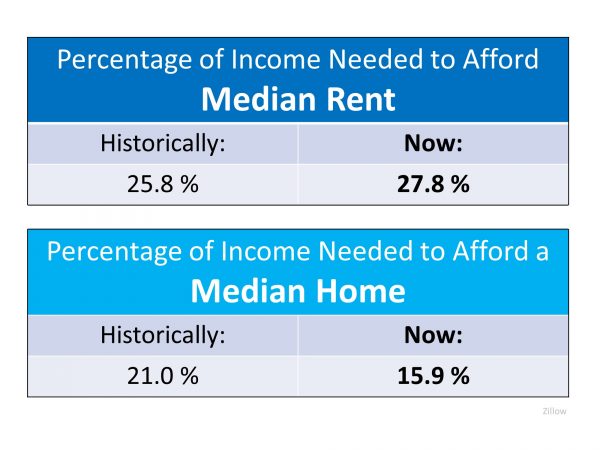
Many, however, fear it is too expensive to own a home. In reality, however, it’s actually more expensive to rent. Here’s the breakdown as a percentage of income necessary for both – affording median rent and owning a home:It’s ‘National Roof Over Your Head’ Day! | MyKCM

Bottom Line

Today we pause to appreciate the places we call home, and all of the other reasons we have to be truly thankful. For those who don’t own yet and would like to, it’s a wonderful time to start identifying the steps to take toward homeownership. Let’s connect today to begin creating your plan.

Rent Vs. Own

Rent Vs. Own [INFOGRAPHIC] | MyKCM

Some Highlights:

  • Owning your own home vs. renting may lead to some great options, such as locking in your monthly payments and having the freedom to customize your living space.
  • Whether you rent or own, you have to cover someone’s mortgage costs. You may as well be doing so to build your own wealth, rather than that of your landlord.
  • Renting and owning both have up-front fees when you sign your lease or close, respectively. Think about putting that money to work for you!

The Cost of Renting vs. Buying This Spring

The Cost of Renting vs. Buying This Spring [INFOGRAPHIC] | MyKCM

Some Highlights:

  • Historically, the choice between renting or buying a home has been a tough decision.
  • Looking at the percentage of income needed to rent a median-priced home today (27.7%) vs. the percentage needed to buy a median-priced home (17.5%), the choice becomes obvious.
  • Every market is different. Before you renew your lease again, find out if you can put your housing costs to work by buying this year!